Monday, July 31, 2006

red-bellied snakes


How do they communicate with each other?

Red-bellied Snakes communicate with each other primarily through touch and smell, especially during breeding. Outside of the breeding season they do not interact much with other snakes. They use their forked tongues to collect chemicals from the air and insert these forks into a special organ in the roof of their mouth, which interprets these chemical signals. Snakes are also sensitive to vibrations and have reasonably good vision.

Communication and happiness. Do they have anything to do with one another? Are the snakes happy?

I came across "The World Map of Happiness"- you need to check this out. Watching young boys in the woods for a couple weeks, as they gift you daily with toads and snakes - but have little need for communication - at least the kind that I can truly understand. And yet, it is obvious that they are happy. And the dog - who must remain leashed when outside in the city - is delightfully happy when she can run and swim and chase her charges (the young boys).

Adrian White said “The concept of happiness, or satisfaction with life, is currently a major area of research in economics and psychology, most closely associated with new developments in positive psychology....” My cynical translation when hearing the worlds "happiness" and "economics and psychology" is that they are trying to figure out new ways to get us to think we need to buy more useless stuff. And yet there are so many simple pleasures to be had.

Why do we forget that so easily?


More quotes from the Happiness Map site:
"There is increasing political interest in using measures of happiness as a national indicator in conjuntion with measures of wealth. A recent BBC survey found that 81% of the population think the Government should focus on making us happier rather than wealthier."

"Further analysis showed that a nation's level of happiness was most closely associated with health levels (correlation of .62), followed by wealth (.52), and then provision of education (.51)."

“There is a belief that capitalism leads to unhappy people. However, when people are asked if they are happy with their lives, people in countries with good healthcare, a higher GDP per captia, and access to education were much more likely to report being happy.”

An entire two lazy weeks up north. Home now and back to school and a schedule. The sabbatical year is officially over for and it has been a wonder and a gift.

Friday, July 21, 2006

The Wonder Years


There is a wonder factor to a twelve year old boy. I love it. I am spending time with four of them up north this week and next.

They are: playing cards and flirting with cheating on each other. Catching frogs and building homes for them. Wondering why I go nuts when they try to use their nets to catch the hummingbirds at the feeder. Swimming with the dog. Building forts and swings in the woods and carving their names into trees. Building a bonfire every night. Whittling. Playing flashlight tag until midnight. Eating - constantly. Waiting for rain sometimes - no screens of any kind unless it is raining - so no movies, tv, gameboys.... Constantly testing their knowledge of constellations, music, fads - of anything - out on each other.

I am: bringing them to the library to (among other things) do research on the frog (excuse me, toad). Giving them oral quizzes on American jazz...I believe they now all know the difference between Frank Sinatra and Mel Torme. Forcing them to eat vegetables, take showers and check for ticks. Singing to them until their eyes roll back in their heads - especially opera. Playing cards with them - they play like a bunch of old grumpy men. Making them pick up - their clothes, their soda cans, the watermelon rinds off the lawn, their dishes. My nick-name - the enforcer.

Reading


As I am ranting about the unfolding events this week - trying to make sense of it all - I've finished a book that I found oddly comforting - mostly because I thought it was going to be a lite "summer-read" and it made me think about so many other things, including the senseless events of late. I recommend Anderson Cooper's "Dispatches From the Edge: A Memoir of War, Disasters and Survival."

I have been wondering for quite awhile why I like the way this man does his job. I like to think it is more than just his waspy good looks - the blue-eyed, silver-haired wonder. It just seemed like there was something else there that was seeping through my hardened cynicism of anything that has to do with televised news. His book seems to answer some of those questions for me - although it hasn't done a heck of a lot for my hardened cynicism. He is not afraid to make connections between the personal and the global - between the people he is covering and himself. Is this why folks call him a "new breed of journalist" and question his ability to be objective. Where is there any objectivity on the news anyway? (Where is the news anyway?)

I'd be interested to know if anyone else has read this and what you think - either post here or email me.

Tuesday, July 18, 2006

Images from the Middle East


Hello - what are you doing on this beautiful summer day? Watching your children on the beach or the playground. Are you on vacation and sitting quetly in the sunshine. Having to go to work and grousing about the traffic, the project, the boss? Perhaps you are weeding your garden or working on a beloved project in the studio. Are you walking through the farmers market? Are you watching the birds at your feeder? Are you wishing you were somewhere else? Spend a moment with these images and take a moment to imagine this as your beautiful summer day. What will you do to help?

Friday, July 14, 2006

Subtraction 7.0


Bravo! Click on the title to visit Subtraction. I love finding these. A smart and interesting site - with enough to look through and ponder for quite a while.

Thursday, July 13, 2006

Tuesday, July 11, 2006

Reunions and other travels


By now there is enough stuff floating around on the web about the Smith/Ellis/Fitzgerald family reunion - that you don't need my two cents worth. For a fine accounting take a look at Dooga-Dooga, Open Space , The Halblog, or Eat Your Broccoli.

I am late because I've been really struggling with uploading images and getting back in the groove of all the other stuff happening of late. When our small nuclear group left the reunion - we headed back towards Seattle (and our flight home) through the mountains of British Columbia.


We spent some time at Manning Park, on Rinty's suggestion (thanks!). About the size of Connecticut - it is an amazing series of mountains, lakes, trails, alpine flowers, aminals....I'd highly recommend a trip there for anyone. Then on to Vancouver - we were immediately in love with this beautiful, dynamic city - all of us for our own reasons. Mine was (without a doubt) the University of British Columbia Museum of Anthropology. A wonderful collection of First People artifacts - enough to study and learn from for a lifetime.

Monday, July 10, 2006

Great Lakes Town Hall - Home


The Great Lakes basin lands are home to more than 42 million people and each one of them has a story, a concern, a question. In the Great Lakes Town Hall, the Community Bulletin is a place for you and your neighbors to voice them.

Do you have a Great Lakes issue you'd like to discuss? Or perhaps you're seeking information on the Great Lakes or a related place or issue?

The Town Hall is open for you and all visitors. Think of this as your Community Bulletin Board, a place for requests and announcements of general interest to the Great Lakes community.

Tuesday, June 20, 2006

A Hangar, A Pinhole And A World Record: Building The World's Biggest Camera


Sometime in June, a team of photographers in southern California plans to transform an abandoned airplane hangar into a giant pinhole camera, expose a huge piece of light-sensitive cloth, and create what may be the world's largest photograph. The project is difficult and expensive, and if it succeeds, the result will be a single black-and-white image of an empty runway.

So why do it?

To the six photographers involved, Jerry Burchfield, Mark Chamberlain, Jacques Garnier, Rob Johnson, Douglas McCulloh and Clayton Spada, the undertaking is part of something bigger than just a really huge picture. Since 2002, they have been working on a long-term photographic study of Marine Corps Air Station El Toro in suburban Orange County. The air base was shuttered in 1999, and after years of community debate, is slated to be turned into a giant urban park. "It's a way to pay tribute to the base... and its role in what's happening in the county," says Burchfield, a professor and gallery director at Cypress College, a community college between El Toro and Los Angeles. The photographers call their work The Legacy Project, which they say will ultimately be a 15-year study of the air station. To date, they've taken more than 80,000 images and produced two books. The Great Picture, as the group calls it, will measure 25 feet by 100 feet. The hangar that will become their camera obscura is 160 feet long and 60 feet high, and the photographers will hang the cloth at a focal length of 80 feet from the pinhole, Burchfield says.

Incidentally, "pinhole" is an imprecise word; the hole will probably need to be a quarter-inch or more in diameter. Burchfield says the team is conducting experiments with different aperture sizes and exposure times. Most likely, the photo will need to be exposed for five to 12 days, Burchfield says, depending on the results of their experiments. Getting this far has required a lot of creative problem solving. The team had to choose a big hangar that could be made completely dark inside. They settled on Building 115, which faces a runway and control tower that are slated to be ripped up and turned into a landscaped section of the park. To make the hangar light tight, the photographers are contracting a pest exterminator to "tent" the inside of the building. Any leaks will be sealed with black plastic and tape. For the negative itself, no piece of photographic paper was big enough, so the photographers special-ordered a large piece of muslin fabric. Once the hangar is sealed, they plan to coat the cloth with a light-sensitive emulsion called Liquid Light from Rockland Colloid. Los Angeles photo store Freestyle Photographic Supplies is donating 20 gallons of the stuff, Burchfield says. Working under safelights, the photographers will paint on the Liquid Light with rollers and hang the muslin vertically from the ceiling.

Garnier, a photo artist and contract painter, helped figure out how best to roll on the emulsion. It has to be applied at 115 degrees, it must be spread evenly, it cannot come in contact with certain kinds of metal (ruling out the use of a paint sprayer) and it dries in about ten minutes, he says. Even with many of the supplies and services being donated, Burchfield says the project will cost at least $20,000. To fund it, the photographers are pre-selling prints of the image. They plan to shrink the negative by re-photographing it and printing it as a positive and a negative on 30-inch by 50-inch paper. Burchfield predicts the final, massive image will be sharp and have tremendous depth of field, as is the nature of a pinhole camera image. The photographers will unveil the photograph when it is complete, but it won't have a permanent home initially. Burchfield hopes one of the museums being built in the new park will have a place for it. The photographers are working with Guinness World Records to certify their accomplishment as the largest camera and largest photograph, two categories for which Guinness doesn't list any current record holders. Some cursory Internet research supports their shot at the record.

Numerous photographers, including Legacy Project member Spada, have experimented with large pinhole cameras in rooms or vehicles, but there's no evidence of anything this big. Back in 1900, one giant camera used glass plates of 4 1/2 feet by 8 feet, according to an article about camera maker George Lawrence. The Discovery Park science center in Arizona claims on its web site to have the world's largest camera obscura, but the image it only projects is only 5 feet by 12 feet. A University of Colorado at Boulder professor has proposed building a giant pinhole camera in space, which would probably be the largest camera anywhere, if it were ever built.

The Passing of Dr. James Cameron


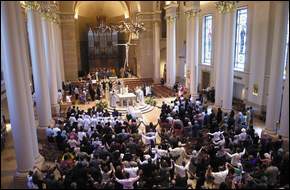
The choir sang yesterday at the funeral for Dr. James Cameron. I will miss his presence in the community - and seeing him each week at Mass.

The following is from the Marion, Indiana Chronicle Tribune. Marion is the city where Cameron was nearly lynched.

Through what he considered divine intervention, Cameron escaped the 1930 lynch mob that hanged two of his friends. His next 76 years were spent as a father, husband, author, educator and community activist. It was a life that brought hundreds of Cameron's relatives and friends Monday to St. John's Cathedral, across the street from the site of the old jail that was broken into to save a black man. They came to bid goodbye to the man they called "James," "Dr. C," "Grandfather" and "Dad."

"He lived 92 years and touched people from every walk of life," said Reggie Jackson, longtime friend and volunteer coordinator and board member at America's Black Holocaust Museum, founded by Cameron. "Dr. Cameron was what I call a soldier. He was a soldier of what I consider to be the most important battle of our life. Dr. Cameron was a soldier in the battle against injustice."

The sweet smell of incense filled the air as the funeral Mass began, and those in attendance joined in a rendition of Lift Every Voice and Sing, known as the African-American national anthem.

The casket was closed, washed in water from the peach marble baptistery and shrouded in a white cloth that bore a red cross.

Attendants carried the casket to a large center altar, where it was placed under a stone sculpture of Jesus suspended from the ceiling below an intricate wooden crown of thorns.

Cameron's family left their seats and walked to the front of the church, followed by members of a fraternal organization to which Cameron belonged and a number of priests, who bowed to the casket before taking their places.

A Bible and a cross were placed on top of the casket. Friends and family walked to a podium to read passages from scripture, many of them dealing with resurrection, rebirth and what awaits the faithful upon death.

"Blessed are those who are persecuted for righteousness' sake, for theirs is the kingdom of heaven," Deacon Edward Blaze said, reading from the Book of Matthew as a sprinkling of "Amen" erupted from the crowd.

Constructed of yellow brick, the Cathedral of St. John the Evangelist takes up an entire city block in downtown Milwaukee. The service was held there because the church where Cameron worshipped on Sundays is being renovated.

"In spite of that, when I sought another venue for the funeral I thought of the cathedral and thought, 'Why not?'" Father Carl Diederichs said. "This is the home church of the archdiocese of Milwaukee, and if there is a man who ought to be revered by the entire archdiocese, it's Dr. James Cameron."

In preparing his sermon for Monday's funeral, Diederichs read parts of Cameron's book, A Time of Terror. The book describes how 16-year-old Cameron, along with Abram Smith, 18, and Thomas Shipp, 19, were jailed in Marion after the killing of 24-year-old Claude Deeter and the reported assault of 18-year-old Mary Ball.

"Look at this picture, this horrible picture, and you see the two hanging there - grotesque, grotesque," Diederichs said before reading the passage where Cameron describes the lynching of Smith and Shipp. "And I see another branch. Guess who it was for? Guess who it was for? Dr. James Cameron."

"I see this day as an opportunity that we can come together not just to mourn our brother," continued Diederichs, who knew Cameron for years, "but to be strengthened by his spirit so it will not happen again."

A few moments later, Diederichs asked the mourners to exchange greetings. As they shook hands and hugged, the words "Peace" spoken in dozens of different tones and accents echoed through the cavernous church.

After communion, family and local officials were invited to the podium to speak.

"As a young child in 1930, he faced death," Milwaukee Mayor Tom Barrett said. "He lived the next 76 years of life as I think any of us would like to live our lives. As an outsider looking in, as a mayor, I say, 'That's the way we should live our lives.' He was committed to his family, he was committed to justice and he was committed to treating people with respect."

Cameron's son Walter described a father who never missed an important occasion in the lives of his five children, three of whom survive.

"He was always at school events, he attended sporting events and anything disciplinary that may have happened at school," Walter Cameron said, his chuckles drawing the crowd to join him. "That was one time only."

When a call came in from someone interested in speaking to James Cameron about his book, he often referred the inquiry to his "agent" - his cousin Tom Wise, a retired Marion police officer.

Wise thanked Cameron's family for allowing him to share the time with the activist and thanked the city of Milwaukee.

"I'm sure it was God's will for James to move to Milwaukee. James loved Milwaukee, and the love Milwaukee shared with James, you can't believe it," Wise said. "If he had stayed in Anderson or Marion, there is no way the legacy of James Cameron would be what it is now."

Then he turned the crowd's attention to a group seated in the back row: Marion Police Chief David Gilbert, Deputy Chief Cliff Sessoms, Fire Chief Steve Gorrell and Stacy Henderson, chief of staff for Mayor Wayne Seybold. Seybold is in Asia on a trade mission with Gov. Mitch Daniels.

As the service neared its end, speakers who met Cameron through their involvement in America's Black Holocaust Museum took the stage. Cameron opened the museum 18 years ago Monday. When the hearse containing his casket passed the museum on the way to Holy Cross Cemetery, red, black and green balloons secured to its roof were released into the sky.

"There was a very public face of Dr. Cameron," said Marissa Weaver, chairwoman of the museum's board. "But there was also a very personal face of Dr. Cameron, and some family members lost a grandfather, there's some children who lost a dad, and his wife of 68 years lost a husband."

She then addressed Virginia Cameron directly. "Miss Virginia," Weaver said. "I know it was hard to give up your husband to the rest of the world, but we really appreciate that you did so."

Tuesday, June 13, 2006

Katie Martin

Katie is absolutely one of my favorite people. Check out the link to her website. This is her latest Milwaukee project - between 38th and 39th on North Avenue. She collaborated with neighborhood young people and the local Boys and Girls Club.

Her fiance, Adam Meurer (and the rest of the gang at FLUX DESIGN) is no slouch either.

Lots of good art and good folk in Milwaukee.


Thursday, June 01, 2006

The poetry of Barbara Crooker


[... Barbara Crooker's Radiance - which won the Word Press First Book Prize - is worth a mention. In these pages the Pennsylvania poet writes both of artists - Rodin, Van Gogh, Cézanne - and the art of living. For Crooker, attention to detail is crucial. She looks at the world with loving attention - noticing the way light falls, the subtle shifts in mood - and even in disappointment she finds some small blessing.]

In "Some October" she writes:

Some October, when the leaves turn gold, ask
me if I've done enough to deserve this life
I've been given. A pile of sorrows, yes, but joy
enough to unbalance the equation.

When the sky turns blue as the robes of heaven,
ask me if I've made a difference.


Thursday, May 25, 2006

24 Hours in A Dog's Life


One minute you are just contemplating the universe - watching the sunset. The next thing you know you have stuck your nose in someone else's business and your whole existence is thrown for a loop.... (20 were taken out at home via pliers, the rest were done at the vet's - another 20 inside the mouth - OUCH!)

Friday, May 19, 2006

Les Cheneaux Community Library


When I am up north, most days I can be found at the library in the early afternoon. It is a great place for me to hook up (they have WIFI) and spend two or three hours doing the part of my work that needs to be done online. Working this way helps me to organize the things I don't do online.... I always make a list before I leave the house - because you don't just "run to the store" up here. So my daily sojourn may also include the grocery store, post office, hardware or pharmacy. I know at least once a week I will probably have to drive to the Soo or to St. Ignace - which is a longer trip. If I need something exotic, like, say - looseleaf binder dividers - or page protectors.....

The plumber told me that the early spring has been dry - but they have made up for it since I arrived. Solid days of rain, lots of wind. The barn next door has partially blown over. The road is flooded going towards Hessel - and lots of trees down. Walking through the wind is exhilarating. I am so grateful to my family that they give me this time up here - it is a real gift.

Last night I finished Joan Didion's book, The Year of Magical Thinking. She wrote it the year after her husband of forty years had passed. I had heard about this book through a family member after John's dad died. Someone had sent her a quote from the book that she then passed on to all of us about mourning, "...the death of a parent [..] despite our preparation, indeed, despite our age, dislodges things deep in us, sets off reactions that surprise us and that may cut free our memories and feelings that we had thought gone to ground long ago. We might, in that indeterminate period they call mourning, be in a submarine, silent on the ocean's bed, aware of the depth charges, now near and now far, buffeting us with recollections."

She then differentiates between this and grief - which she defines as having no distance - and having the obility to obliterate the dailiness of life. The book is a powerful read.

Tuesday, May 16, 2006

Trout Lilies


Trout Lilies
Originally uploaded by SpringChick.

Pixagogo - Blue Note: Over 1000 great jazz album covers

I wonder how many of my sibs could go to this site and pick out the records that sat on the bookshelves in the family room of our house. My dad was a lover of the cool school - and there were plenty of those guys represented in his collection. In the fifties - long before it was popular or even thought of by most folks - he had a small record player installed under the dashboard of his Plymouth Fury. His in-home system included a big stereo in the basement (on his workbench) and wires to speakers all over the house. He wasn't a handy sort of guy. This was a labor of love - and a mess. But it worked. Even though he could only play one record at a time, and my mother would yell for him to "turn it down" constantly, we knew what the cool school was.....


The heat and urgency of bebop began to relax with the development of Cool Jazz. Starting in the late 1940s and early '50s, musicians began to develop a less frantic, smoother approach toward improvising modeled after the light, dry playing of swing-era tenorist Lester Young. The result was a laid-back and even-keeled sound bearing a facade of emotionally detached "coolness."

Trumpeter Miles Davis, one of the first bebop players to "cool it," emerged as the greatest innovator of the genre. His Birth Of The Cool nonet recordings of 1949-'50 are the epitome of Cool Jazz lyricism and understatement. Other notable instrumentalists of the Cool school include trumpeter Chet Baker, pianists George Shearing, John Lewis, Dave Brubeck and Lennie Tristano, vibraphonist Milt Jackson and saxophonists Stan Getz, Lee Konitz, Zoot Sims and Paul Desmond.

Arrangers, too, contributed significantly to the Cool Jazz movement, most notably Tadd Dameron, Claude Thornihill, Gil Evans and baritone saxophonist Gerry Mulligan. Their compositions focused on instrumental colors and slower-moving, more suspended harmony, which created an illusion of spaciousness. Dissonance played some part in the music as well, but in a softened, muted way. Cool Jazz allowed room for slightly larger ensembles; nonets and tentets were more common than during the lean-and-mean bebop years. Some arrangers experimented with altered instrumentation, including conical brass like french horn and tuba.

Jazz players making their livings in the recording studios of Los Angeles picked up on the Cool Jazz movement in the 1950s. Largely influenced by the Miles Davis nonet, these L.A.-based players developed what's now known as West Coast Jazz.

Like Cool Jazz, West Coast Jazz was much more subdued than the frantic bebop that preceded it. Most West Coast Jazz was scored out in great detail, and it often sounded a bit European with its use of contrapuntal lines. However, the music left wide-open spaces for long, linear solo improvisations.

While West Coast Jazz was played mostly in recording studios, clubs like the Lighthouse on Hermosa Beach and the Haig in Los Angeles often presented top players of the genre, which included trumpeter Shorty Rogers, saxophonists Art Pepper and Bud Shank, drummer Shelly Manne and clarinetist Jimmy Giuffre.

Tuesday, May 02, 2006

Thank You Stephen Colbert

White House Correspondents Dinner:

Colbert attacked those in the press who claim that the shake-up at the White House was merely re-arranging the deck chairs on the Titanic. "This administration is soaring, not sinking," he said. "If anything, they are re-arranging the deck chairs on the Hindenburg"

Click the link and watch the entire thing.