"To lose yourself: a voluptuous surrender, lost in your arms, lost to the world, utterly immersed in what is present so that its surroundings fade away. In [Walter] Benjamin's terms, to be lost it to be fully present, and be fully present is to be capable of being in uncertainty and mystery."
Monday, April 16, 2007
From: A Field Guide To Getting Lost
"To lose yourself: a voluptuous surrender, lost in your arms, lost to the world, utterly immersed in what is present so that its surroundings fade away. In [Walter] Benjamin's terms, to be lost it to be fully present, and be fully present is to be capable of being in uncertainty and mystery."
Friday, April 13, 2007
Setting Type
In a story by Ray Bradbury, Farenheit 451, there is a group of people who, in order to save them, memorise books, and are called "walking books"! Other similarly claimed substitutes abound in so-called book-artists' jargon, but the memories of books are not yet in book form, and so cannot be called books or have bookness. One could say however that a pack of Tarot cards does have bookness. It functions as a working group of loose-leaf planar surfaces with related images conveying textual matter in pictorial form. Traditional knowledge has it that the Tarot is in fact a philosophical treatise. The planes of a book have a necessary relationship or they simply become a collection of arbitrary planes for which a book format is not essential for the conveyed meaning. Many arbitrarily devised objects such as chewed or dissolved texts in bottles, etc., may or may not be art objects, but they are not objects with bookness. The book-maker's art should be distinguished from the art-maker's book. The book is generally thought of as a compact, conveniently portable mobile object (although there can be giant books, made of any material). The book, as book, has multiple planes because all the text or material it contains would be too unwieldy in a single planar form. There are book-like objects or appearances and object-like books, but that is a different story.
© Philip Smith 1996
Wednesday, April 11, 2007
Monday, April 09, 2007
HOW CAN THERE BE SUCH COLOR??
This is from a recent trip that Elijah and I took to the Domes...it was sleeting outside - a pouring rain that really wanted to be snow. But inside the tropical dome - we found this!!!
Sunday, April 08, 2007
The Ecstacy of Communication -Implications in the Virtual World


Reading an article by Denise Carter from the UK. Trying to research how virtual communites impact not only students - but individuals in general. Set within the wider context of the Internet and society it investigates how geographically distant individuals are coming together to inhabit new kinds of social spaces or virtual communities. People 'live in' and 'construct' these new spaces in such a way as to suggest that the Internet is not a placeless cyberspace that is distinct and separate from the real world. Building on the work of other cyberethnographers, the author combines original ethnographic research in Cybercity, a Virtual Community, with face-to-face meetings to illustrate how, for many people, cyberspace is just another place to meet.
Second, she suggests that people in Cybercity are investing as much effort in maintaining relationships in cyberspace as in other social spaces. This analysis suggests that by extending traditional human relationships into Cybercity, they are widening their webs of relationships, not weakening them. Human relationships in cyberspace are formed and maintained in similar ways to those in wider society. Rather than being exotic and removed from real life, they are actually being assimilated into everyday life. Furthermore, they are often moved into other social settings, just as they are in offline life.
However, experience shows that they can harbor the same emotional issues that real-life relationships do - further implications ensue as a result of role playing and the "gaming" mentality of some of the inhabitants.
Issues to examine as more and more educational institutions have a presence on these communities.
Tuesday, April 03, 2007
Wednesday, March 28, 2007
Second Life Red Cliffs

Snapshot of me on the red cliffs in second life. Late at night, rainy here....but endless possibilities abound there....
under the sea
In SL - where I have been spending a lot of time lately - I have been watching a friend build a lake - with houses on stilts, a beach to come - all very beautiful....so I am dreaming of life under the seas tonight.
Sunday, March 04, 2007
Wednesday, December 20, 2006
A torch passes - Tech_Space - USATODAY.com
Alas, that would be a literal torch, thanks to Second Life -- Lawrence Lessig, the prime mover behind the Creative Commons movement, really did hand a visible torch to Joi Ito Friday night to signify handing off chairing duties for that
organization. I miss metaphor, don't you?
Still, in a weekend oversaturated with no-less-overwrought-for-being-overdue tributes to user creativity throughout the Net (I knew it was going to be a long one when a music critic of my acquaintance breathlessly announced that YouTube and MySpace were his Artists of the Year), I like this one.
It's YouTube and MySpace that got the attention this year (blogs having had their gee-whiz moment a minute back), but the foundations of those services are shaky, precisely because they are in many ways predicated on material that could get lawyered up at any moment. The Creative Commons movement is lawyered up. Creative works with a CC license are genuinely part of the promise of user-generated content, because CC-specifying copyright owners have taken care to say exactly how their works can and cannot be remixed, reused and reproduced.
That, to me, is a strong and healthy foundation for Web 2.0, or user-generated content, or what you will. And it'll advance the cause a lot fast than any foolish X-of-the-Year awards.
Tuesday, December 12, 2006
kick push

I'm listening to a lot of Stevie Wonder and Lupe Fiasco these days. Check it out.
Look for changes to the blog soon. I am going to post the course blogs from the past semester - and I've started a new one that is just for the exhibit I am curating. The link to that is stcf.miad.edu.
The semester is over this Friday. I am grading and working on the exhibit. Holiday season?! Well - somewhere in there!
Saturday, December 02, 2006
CyberOne: Law in the Court of Public Opinion
This is an amazing teaching idea - and I feel as if I have made some remarkable discoveries here. This past week in the course I am teaching - Printed Page/Virtual Page - we had some interesting discussions about Sec. Life and how/why it's existence and uses. I often feel that our discussions hover at the level of popular culture and don't have the depth I would like. Mostly I take the responsibility for this - for I often feel at a loss as to how to take the conversations to another level. Everytime I teach this course I make new discoveries that are happening almost faster than I can accomodate them.
Bravo to Cyber One!!
Saturday, November 18, 2006

You know it's been a good week when you have been able to spend time with both Corey Archangel and Cyro Baptista [Beat the Donkey].
Check out all of the stuff on Archangel's site - well worth wading through everything. I especially like the Beach Boys/Ghetto Boys mash up he does.
Cyro Baptista was at Alverno - the Beat the Donkey performance included some work with Roosevelt Middle School of the Arts which was really fun to see.
Saturday, November 04, 2006
From the Milwaukee Journal
Machine-gun proposal hits rough waters
By DAN EGAN
degan@journalsentinel.com
The U.S. Coast Guard has spent its entire history building an incredible reservoir of goodwill in the Great Lakes.
From the countless rescues of distressed mariners to the ice-breaker Mackinaw's annual Lake Michigan run with a load of North Woods Christmas trees for Chicago's needy, people on the lakes - drunken boaters excluded - have always been happy to see the bright red ships steaming their way.
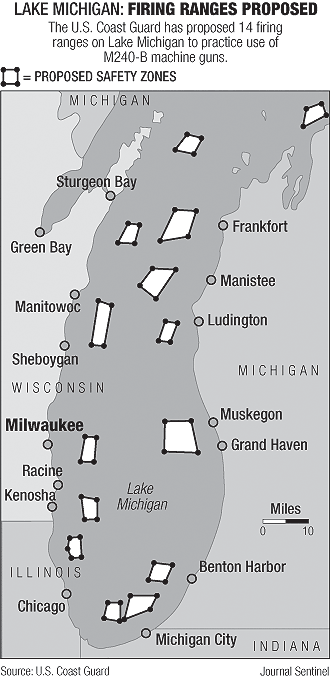
And then the agency got its new machine guns and quietly announced in August a desire to create 34 massive - and permanent - firing ranges for a weapon that can shoot 10 lead bullets a second. It was, the Coast Guard explained, all about steeling its crews for the war on terrorism.
But now it is the agency itself that has a lot of people terrified, both in the U.S. and across the lakes in Canada, which shares ownership in the world's largest freshwater system, a drinking source for millions.
The major worries:
• The potential dangers associated with annually dumping in the lakes more than 3 tons of lead in the form of spent bullets.
"We run the risk that terrorists have succeeded in getting us to poison our own lakes without ever having set foot in the Great Lakes basin," said Hugh McDiarmid Jr. of the Michigan Environmental Council.
• Safety of recreational boaters and commercial operators who might tragically stray into one of the Coast Guard's designated "safety zones" during a live-fire exercise.
"When people are thinking of where they're going to go fishing, are they going to go to the place that's quiet? Or the place where people are shooting?" asked Duluth Mayor Herb Bergson. "It's not a good tourism thing."
• An increased militarization of what has been a famously non-militarized border between the U.S. and Canada.
"Canada is not harboring terrorists planning a marine assault on the United States across the Great Lakes," Green Party of Canada leader Elizabeth May said in a news release this month. "The notion is ludicrous."
The plan, initially released in the relatively obscure Federal Register in August, was put on hold at the end of the summer after an outcry from environmental and boating communities, as well as regional politicians.
The Coast Guard now is going to great pains to tell its side of the story. At the same time, it expanded the public comment deadline from Aug. 31 to Nov. 13. It is holding nine public hearings across the region, including one Wednesday in Waukegan, Ill., and another Nov. 8 in Sturgeon Bay.
Standing at a podium flanked by a painting of an icebreaker and another of a helicopter hovering over someone clinging to a swamped boat, Coast Guard Capt. Bruce Jones made no apologies for a plan that has so many people appalled during a news briefing held last week at the Milwaukee Coast Guard station.
He said the guns are needed "to ensure that our crews are prepared to respond to any future threat or increase in threat level on the Great Lakes - including our 13 nuclear power plants, 22 high-capacity passenger vessels and ferries and 11 major ports."
Added protection
Coast Guard crews have long been equipped with weaponry, typically handguns, shotguns and M-16 machine guns.
Jones said the firing zones are needed now because crews need to train regularly on the new, more powerful M240-B machine guns. Thirty-four such zones are required to ensure efficient use of manpower; crews that train close to their base, he said, will still be available for search-and-rescue calls. There are 14 proposed zones on Lake Michigan alone, including one about 10 miles east of downtown Milwaukee. All of the proposed zones are at least five miles from shore. The guns can fire a maximum distance of about two miles.
Jones said the zones would be used sparingly - each "several" times a year for three or four hours - and that the areas will otherwise be open to the public. He added that the Coast Guard would try to conduct the training in off-summer months when recreational boats typically don't ply the mid-lake waters but said the agency wanted to retain the right to use the firing ranges any time of year. Coast Guard officials say they need to train on water in order for crews to learn how to safely and accurately use the guns in the real-life scenarios they may encounter.
Jones said warnings would be broadcast on marine-band radio before any bullets are fired, and a second watch boat equipped with radar would be on the lookout so crews could intercept wayward sailors before they strayed into the live-fire zones.
He called the volume of lead deposited in the water and its effects on the environment "negligible," and pointed to an 82-page environmental study the Coast Guard paid an outside engineering firm to conduct as evidence.
Environmental groups may not like the idea of all that lead going into the lakes, but Richard Rediske, an expert in environmental chemistry and aquatic ecology from Michigan's Grand Valley State University, agreed that the small chunks of lead on the bottom of the middle of lakes pose little risk to the environment or human health.
Maybe that's true, said McDiarmid of the Michigan Environmental Council, but he won't be thoroughly convinced until the Coast Guard conducts an exhaustive environmental impact statement on the proposal.
Passive past
For some, the biggest issue is the potential to disrupt the pacific history the U.S. and Canada have enjoyed on their shared Great Lakes.
The smooth sailing started just after the War of 1812, when the two countries signed the Rush-Bagot Agreement of 1817, which limited the number of naval weapons each country could employ on the Great Lakes to three 18-pound cannons.
That treaty worked well for more than a century, but Canada recognized it was too dated to be relevant when it approached the U.S. following World War II and asked to take another look at it.
The countries entered into a new arrangement in which both sides agreed ship-based armaments could be increased for training purposes, provided each country gave the other detailed information about the new weaponry.
So when the Coast Guard decided it wanted its crews to carry bigger guns three years ago, the U.S. sent a delegation to Canada.
Canada's formal response: Not a problem. In fact, the weapons proposed were of such small caliber that officials with the Canada Department of Foreign Affairs and International Trade said the guns would not trigger consultation under the Rush-Bagot Agreement.
The Coast Guard moved ahead, and training began on the lakes last winter in several temporary firing zones.
The Canadian federal government might have signed off on the new weapons, but local Canadian leaders have made it clear in recent weeks they are not happy with the plans for training ranges on the shared lakes.
Similar worries exist on this side of the border.
Dan Thomas, president of the Great Lakes Sport Fishing Council, has gotten over his initial hostility toward the plan. But he still has problems with the proximity of the live-fire zones to shore and the way the Coast Guard went about announcing the proposal.
"Basically, the Coast Guard shot themselves in the foot on how they initially went about in not informing us," he said. "It (followed) the law, but it certainly wasn't appropriate. It violated . . . the excellent relationship that the Coast Guard and recreational boating communities have had for so many decades."
Jones, the Coast Guard captain, doesn't disagree that more could have been done to notify the public.
"In retrospect, that was a mistake," Jones said. "And we're making up for it now."
That doesn't mean people still won't have problems with the plan.
One of the things that upsets Cameron Davis of the conservation group Alliance for the Great Lakes is the scope of the training ranges, which cover 2.5% of the lakes' surface, or more than 2,300 square miles.
He worries the proposal could have a bigger impact on the future of the lakes than some people think.
"As far as the ecology of the lakes, there are much bigger issues than this," he said. "However, if people are scared to go out on the lakes, they won't love the lakes. And if they don't love the lakes, why will they care for them?"
Wednesday, October 25, 2006
Like Reefer Madness - only with "internets".....
Saturday, October 21, 2006
Smoking Tree

And now one of the most beautiful pieces i've seen at Ars Electronica Center.
What happens when trees are no longer able to turn carbon dioxide into the oxygen we need to breathe?
During the day
In southern Ireland near John Gerrard’s home, an oak tree’s leaves suddenly cease producing oxygen and instead begin to give off carbon. The Smoke Tree is in fact a virtual sculpture. The polluting process unfolds over a whole day creating an ever-changing tableau, a sculpture in virtual smoke which presents a disquieting yet strangely plausible possibility.
At dusk
Over time the tree is weakening and producing less smoke. In approx. 200 years the tree will eventually stop producing smoke and fall rendering the work as a landscape from that time on.
As in previous works (see Watchful Portrait and The Ladder) the presentation frame operates as a navigation device, allowing the public to look around the tree as an 'image object' or virtual sculpture.
Video.
Wednesday, October 11, 2006


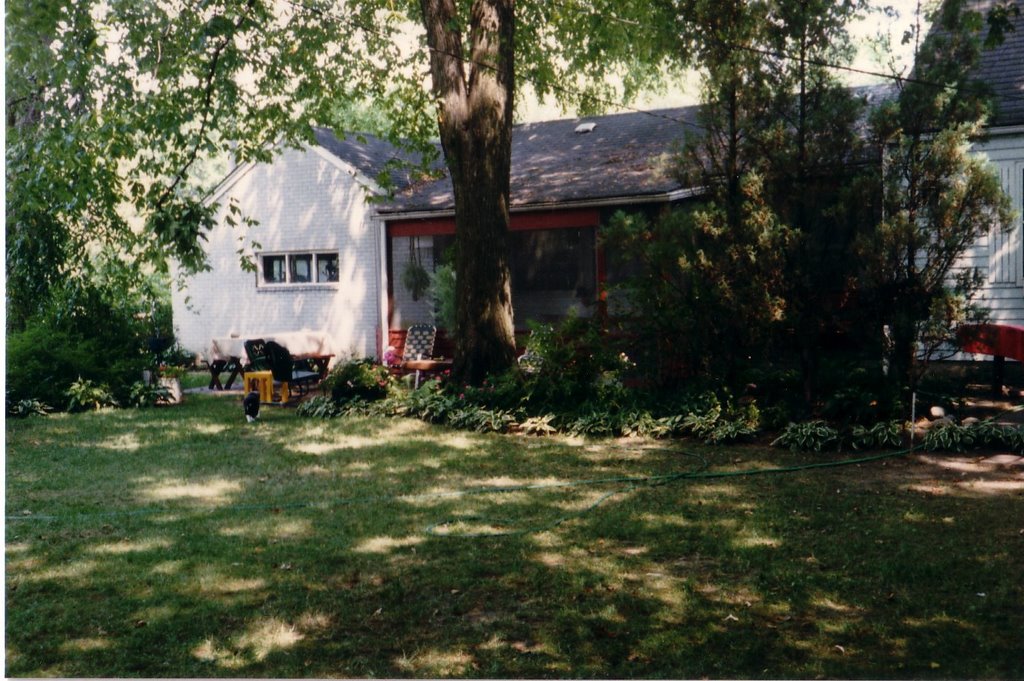
They Have Torn Down My Parent's House
it was made of wood and brick.
The windows they removed. To them it's real
estate, to me it's my heart being ripped in two.
The realtors, the bankers don't understand.
A house is made of family. My parent's house is a memory that will
endure after it's torn down.
They've been gone for not so many years, but I wanted this
house to live on.
I know the world is made of change, and change
is all that's real. But one thing I cannot change,
that is the way I feel. I mourn again,
because they have torn down my parent's
house, and it gives me pain. It was my house for many years.
My parents and sister died in it - I brought my children home to it.
I see us there all as if it were yesterday,
our laughter and tears in the rooms and up and down the hall.
The house once stood to remind me, but that too
is gone. They have torn down my parent's house,
it was made of wood and brick.
Yet a house is more than made of wood,
a house is made of love.