Monday, December 12, 2005

Raising Chicks: Chick Christmas Tree Fun


Ben and Heather's chickens have started blogging - among all of the other adventures they are having, like getting ready for Christmas and enjoying their first Great Lakes winter. Here is how they introduce themselves on their blog.....

"We were born in Texas on October 26, 2005. Ben ordered four hens, but we decided to surprise him and mix it up a little. Actually there's eleven of us now, some roosters and some hens, but we are all chicks. Shipped straight from the egg to Milwaukee and arrived one day later...follow our blog to find out about all of our adventures."

I highly recommend you check them out!

Thursday, December 08, 2005

The many shapes of prayer


In Prayer: A History, Smith College professors Philip and Carol Zaleski take an unusually probing and thoughtful look at a topic that might otherwise seem to defy academic treatment.

The Zaleskis define prayer as "action that communicates between human and divine realms." They trace prayer across time and cultures and find it in expressions as diverse as the funerary rites of Neanderthals, the poetry of Emily Dickinson, the Sun Dance of the Cree Indians, and the admission by Alcoholic Anonymous members that they need the help of a higher power to stay sober.

They also distinguish between different types of prayers, such as those that ask for specific help ("the prayer of the refugee"), prayers that arise spontaneously at moments of crisis ("de profondis prayer"), and prayer that is part of a routine ("devotional prayer.")

The Zaleskis' treatment of their topic is sensitive. Nonbelievers will appreciate the fact that they don't argue for the efficacy of prayer. (They are, in fact, fairly negative about studies that purport to demonstrate a link between prayer and improved health.)

Those who do believe will enjoy the respectful - and occasionally even poetic - tone applied to the subject, as well as what appears to be a real understanding of the actual process. (Contemplative prayer is a "grueling enterprise," they point out, because the human mind, as capricious as a monkey "eagerly seizes any opportunity for woolgathering.")


20051126-dn-020
Originally uploaded by mrbula.

Friday, December 02, 2005

Milwaukee Renaissance

An Urban Manifesto

A collaboration by James Godsil and Bill Sell.
First read at Timbuktu, March 17, 2004.

Copyright © 2004, William Sell, Milwaukee, Wisconsin

CLAIM. I am Milwaukee. I am the face of Milwaukee, its fellow worker, its lover, its dinner companion. I believe in neighbors, that people were evolved to live close, and work near their children. I gladly share this pen with the person I meet on the bus. He writes a phone number and so it may be that the city works for him. I gladly share my house, garden and sidewalk, my alley, county park, and freeway. I believe in public space which, enjoyed, is the guarantor of my private space, my right to speak and play.

PICNIC. I see Georges Seurat sitting in my 21st century park painting the Sunday picnic. Evenings he leaves quietly, history under his arm, without envy for families, their food, or their children. The County Parks are canvas for the art of family. Bring your children, your grill and keg, sing and dance and rouse the indolent budget slashers who would ring our parks with fences and fees.

WORK. I was founded by the worker fleeing hard times in Europe on rumors of hope. Hope — free of dictators — launched my city; and so our children remember their stories. A healthy city offers each worker bread for skills, the chance at work that causes boasting among children on the playground.

LOVE. I will. I, Milwaukee, will end fears of skin and gender. Pose and shunning will be resolved into respect. It is the black and white truth: we will talk love or die; we will teach our children what we do, not what we say. We will be proud of what we leave them. We will tune out media who hawk our fears for profit. We will listen to each other in our public spaces, on buses, in church. We will sit together and share food. We will love one another.

MARRIAGE. Our children shall pick their own partners. Marriage is the supreme act of freedom of two souls. The state shall protect your choice, your spouse and your child. We will remember how, before there was a Milwaukee, grown children were ripped from their families and shipped over seas to be slaves. Milwaukee once boasted a stop on the underground railroad. But today Milwaukee will be destination. You come; you stay; you prosper—whatever the color of your skin, your religion, or gender choice. The rainbow is the promise after the storm, and every color and marriage belongs here. Milwaukee is rainwater and rainbow, shining in the sun. I have a dream.

TRADE. The market is godless. The city divine. The marriage of market and city is a supremely human endeavor, not given to succeed if it serves a few, not condemned to fail if it serves all. This marriage works because service prospers. People talk love in their markets and by doing so restrain the hand of the blind corporation.

LEARN. Raising children is why people do cities, the act of putting our children on firm ground bathed in opportunity to explore the world. Our giants walk the campus preparing to bring the urbanity of Milwaukee to the world.

DEFEND. Though we live under the dark cloud of international crime and benighted politicians, we believe there is strength when citizens gather on sidewalks, organize in precincts, share our air waves, debate in the media. When citizens re-invent media to repair their democracy, cities wake up and there will be no trespass.

BLOOD. The blood of our children is not available to foreign adventure. We will organize, governments will listen. We demand the end to the killing, a United Nations empowering not powerful nations but all nations. We will stop the blood trade in weapons—foreign and domestic. National security is built on the security of the neighborhood, education of children, health care and work; thus will security make each citizen a stakeholder.

VISITOR. You recognize our city perhaps better than its residents and for that we prize your visit. To those who would do us harm, I invite you to share our food, sample our cheese and beer, stay and prosper with us, make your life, practice any religion or none, raise your children. As I rescued Germans, Irish, Jews, Hmong, and El Salvadorans from their wars, so do I make a place for you, as the earlier native has done for me.

CONSPIRE. When democracy gives us weak politicians, the citizen will emerge strong. One citizen empowering another citizen is the conspiracy of democracy. The lies and broken promises of politicians will not fracture the trust among their makers.

REMEMBER. Milwaukee has been roused from the lure of trendy development, asphalt, and slick suburban error. We conspire to preserve our parents' civic memories, to love our commonly held libraries, to touch old buildings with awe, and to make do with what we have. To build wealth from wealth and not from neglect. Milwaukee invests the ninth generation with the natural treasures of creation.

"Let us put our minds together, and see what life we will make for our children." (Tatanka Lotanka)

To these public values, we make a pact among ourselves to work and invite our government to follow us.

INVITE. I invite you who have left Milwaukee to return. Come back and help us remember our ethnic heritage, from Somalia to Ireland, from Mexico to Poland, from Vietnam to Serbia. Come to folk dan'''ce, to feast, to fest. To restore Folk Fair, Milwaukee's original festival, to its golden years in the public square.

Come to Milwaukee and swim in our Great Lake, and by doing so demand that it remain clean. Garden, and husband your soil to clean the water before it returns to our Great Lake.

Bring your bicycle. Ride the Oak Leaf trail through our spectacular County Parks. We lay bare our shameful failure to finish this project. With your help we will one day ride on the Hoan bridge and connect the great Bay View village to the Downtown village, to give our children a view from the top of the city.

Sit in our audiences and bask in theater, dance and music. Come to school. Milwaukee Public Schools need you: advocates, teachers, parents, neighbors, retired people to read aloud, to attend to lighthouse schools in the late afternoons while parents finish their employments. Our children will shine if their efforts are graced by the attention of many adults. The village raises its children; but children create their own village.

Thursday, December 01, 2005

The first signs of Christmas

For while all things were in quiet silence and the night was in the midst of her course......

Wisdom of Solomon 18:14-15

Wednesday, November 30, 2005

snow globe for the coasts


But won't you be ashamed
To count the passing year
At its mere cost, your debt
Inevitably paid?
For every year is costly,
As you know well. Nothing
Is given that is not
Taken, and nothing taken
That was not first a gift.

The gift is balanced by
Its total loss, and yet,
And yet the light breaks in,
Heaven seizing its moments
That are at once its own
And yours. The day ends
And is unending where
The summer tanager,
Warbler, and vireo
Sing as they move among
Illuminated leaves.

~ Wendell Berry ~

Sunday, November 27, 2005


A man goes into a bar with his little Jack Russell terrier. He puts the dog on the bar stool next to him. The bartender wanders over and the man says: "I'll have a pot thanks, mate." The dog says: "I'll have the same."

The bartender does a double- take and looks over to the dog and asks: "Did you just talk?"

"Yep," says the dog. "My God! That's incredible. This is unreal. Who would have thought: a talking dog, here in my bar? Tell me more about yourself. You must have had an amazing life as a talking dog."

The dog assumes an indifferent pose and speaks in quite a matter-of-fact manner.

"Yeah, you could say it's been a journey. I trained for a while with the US Marines. Saw a bit of action in Iraq - can't tell you more. I joined the Bolshoi Ballet for a stint. That was hard work but incredibly satisfying. I've written a few best-selling novels in my spare time. That was good fun. Of course, there have been film offers, TV shows. Wine, women and song. All that."

The bartender is now purple with excitement. He turns to the man. "We could make a fortune. We could charge people to come into this bar and hear your dog talk. How much would you charge to allow your dog to talk here?"

"About $10," the man replies.

"Why only $10 - that's madness," exclaims the bartender. The man answers: "He's a liar. He hasn't done half those things."

Monday, November 21, 2005

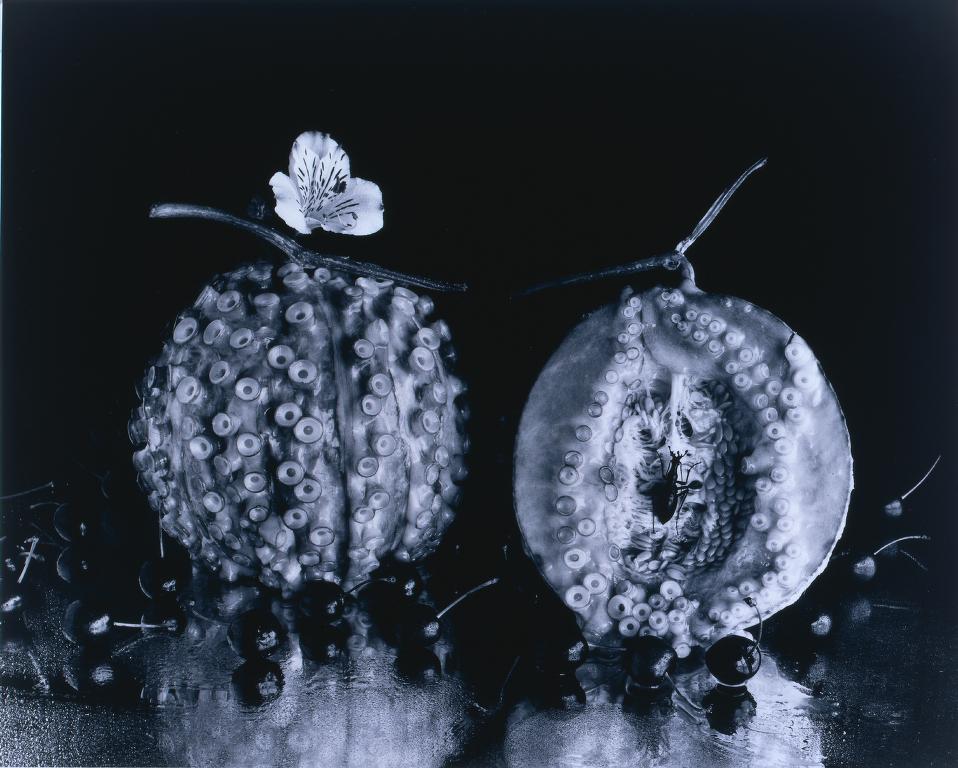
CAMIO: On-line Images


Testing an image database of online Art Museum Images. These are wonderful tools for teaching - in any subject - but particularly in art history and studio art/design courses. We are finding them great resources at MIAD as are many other educational institutions.

Their description (via MIAD Librarian, Cynthia Lynch):

Camio offers right-cleared, high quality art images for class projects, art history and studio art programs, course Web sites, lectures, presentations, and research resources. Access by subscription is available to universities and colleges public libraries, museums and schools.

I am counting on the fact that this blog is utilized (among other things) as a "course web site" and seeing how this works for posting images.

Your looking at:

OCTOPUS AND MELON, 1989
Michiko Kon, Japanese b. 1955

Getalin Silver Print
Cleveland Museum of Art

Lovely isn't it?

Sunday, November 20, 2005

Accueil Flipbook.info


The original animation. A great site to play on.

Homespun Magixx - Downloads


There are all sorts of free downloads on this site - enough to keep anyone occupied for hours....links to other interesting places and some great paper engineering ideas.

Friday, November 18, 2005

The Midnight Special - Folk Music with a Sense of Humor


Driving back to Milwaukee on 65 through Indiana - late night, lots of trucks, big moon lighting up the fields and this music coming from the radio - wonderful, rich, grand music. It is this show - the Midnight Special. I get to my hotel room - I have to stop - it's well past midnight and I am way too tired to keep driving. I go immediately to their website - the playlists (with links). Ahhh - I love the way I can find all of this.

Thursday, November 17, 2005

Book Art


Spending the week in Versailles, Kentucky making books with all of the young people at St.Leo's Elementary School. Every grade level is making a different book structure - and working with a different theme. Rose and I are organizational wizards - it is always easier with two. She doesn't have a classroom - so we prep, pack, get in, work with kids, clean-up, and get going to the next room.

Teachers of young children: truly the unsung heroes of our time. More pictures to follow.

Friday, November 11, 2005

The First Sports Post


I have been told (by those that know) that the current state of NBA basketball is a sorry one. Flaccid and boring - even people who normally get excited about such things are not happy campers. Not so last evening - when the Huskies from Michigan Tech hit the court against the (this week) Golden Eagles from Marquette University. Gritty and raw - the game was a knuckle-whitener from beginning to end.

Can too much be said about the performance of number 21? One thinks not.

Thursday, November 10, 2005

flora_arje.jpg


flora_arje.jpg
Originally uploaded by kolkkaaja.
From the free-style sushi set on kolkkaaja's flickr site. Nice work!

Tuesday, November 08, 2005

Monday, November 07, 2005

Marjane Satrapi at Coastal Carolina University Ourmedia

The title of this post will take you to a quick-time interview with Satrapi. If you haven't read Persepolis - I really encourage you to do so. I was thinking about her this morning, as Art Spiegelman (who wrote Maus, among other things) - will be speaking at UW-Milwaukee at the end of November. In this excerpt (from the Pantheon site), she talks about writing Persepolis - which now has a sequel - as well as gives a bit of background about graphic novels.

ON WRITING PERSEPOLIS
By Marjane Satrapi, as told to Pantheon staff
Marjane SatrapiChances are that if you are an American you know very little about the 1979 Iranian Revolution. "This revolution was normal, and it had to happen," says Marjane Satrapi, author of Persepolis, a totally unique memoir about growing up in Iran after the Shah left power. "Unfortunately, it happened in a country where people were very traditional, and other countries only saw the religious fanatics who made their response public." In her graphic novel, Satrapi, shows readers that these images do not make up the whole story about Iran. Here, she talks freely about what it was like to tell this story with both words and pictures, and why she is so proud of the result.

After I finished university, there were nine of us, all artists and friends, working in a studio together. That group finally said, "Do something with your stories." They introduced me to graphic novelists. Spiegelman was first. And when I read him, I thought "Jesus Christ, it's possible to tell a story and make a point this way." It was amazing.

Persepolis Writing a Graphic Novel is Like Making a Movie

People always ask me, "Why didn't you write a book?" But that's what Persepolis is. To me, a book is pages related to something that has a cover. Graphic novels are not traditional literature, but that does not mean they are second-rate. Images are a way of writing. When you have the talent to be able to write and to draw it seems a shame to choose one. I think it's better to do both.

We learn about the world through images all the time. In the cinema we do it, but to make a film you need sponsors and money and 10,000 people to work with you. With a graphic novel, all you need is yourself and your editor.

Of course, you have to have a very visual vision of the world. You have to perceive life with images otherwise it doesn't work. Some artists are more into sound; they make music. The point is that you have to know what you want to say, and find the best way of saying it. It's hard to say how Persepolis evolved once I started writing. I had to learn how to write it as a graphic novel by doing.

What I Wanted to Say

I'm a pacifist. I believe there are ways to solve the world's problems. Instead of putting all this money to create arms, I think countries should invest in scholarships for kids to study abroad. Perhaps they could become good and knowledgeable professors in their own countries. You need time for that kind of change though.
I have been brought up open-minded. If I didn't know any people from other countries, I'd think everyone was evil based on news stories. But I know a lot of people, and know that there is no such thing as stark good and evil. Isn't it possible there is the same amount of evil everywhere?

If people are given the chance to experience life in more than one country, they will hate a little less. It's not a miracle potion, but little by little you can solve problems in the basement of a country, not on the surface. That is why I wanted people in other countries to read Persepolis, to see that I grew up just like other children.

It's so rewarding to see people at my book signings who never read graphic novels. They say that when they read mine they became more interested. If it opens these people's eyes not to believe what they hear, I feel successful.

Sunday, November 06, 2005

A Daily Dose of Architecture: Follow-up #1: Water Tanks

Chicago Architecture Club has recently announced the winners of Chicago Prize for 2005: Water Tanks, a competition that challenged entrants to salvage a part of Chicago's urban fabric, the industrial water tank, through creative reuse and preservation.

watertank3.jpg

First prize went to Rahman Polk who had imagined to turn Chicago's water tanks into a network of electricity-generating wind turbines...water tanks around Chicago would be transformed into a network of electrical generators that would create a citywide, publicly accessible WiFi network and use LED displays to broadcast Webcasts, cultural exhibits, Amber alerts, weather warnings and other public service announcements."

Another interesting design, "Sanctuary," won an honorable mention for its vision of the water tanks as UN-administered refuges for people seeking political asylum or those fleeing detention by the U.S. government.

(Originally seen on "WE MAKE MONEY-NOT ART")

tunnel


tunnel
Originally uploaded by shalberg.

Thursday, November 03, 2005

about del.icio.us


This is from: Joho the Blog: [berkman] Joshua's news.
If you aren't using del.icio.us yet - I really encourage you to check it out.

Joshua Schachter of del.icio.us is giving a lunchtime talk. His presence has sold out the small conference room at the Berkman Center so we've moved to a bigger room.

What follows are paraphrases of what he said; I am certain not only to have omitted much but to have gotten stuff wrong, so before you get pissed at Joshua for saying x, you might want to check that he in fact didn't say y and I said he said x.

He built delicious in 2003 to manage his own links. He had been using a text file, but twenty entries into it he had already introduced a tag into it.

Currently at delicious: 5M links, about 10M posts, on average about two tags per item. About 500,000 unique tags. Growth in tags is slow.

The Chinese firewall blocks delicious now.

Hard core tech pages have gone from 25% to 17% over the course of this year. "So interests are starting to broaden."

Q: How would you describe delicious to a layperson?

A: It's a way to remember stuff. Links initially but we're adding some new types.

Q: Delicious is aggressively without a user interface, so I think of it as a pipe instead of as a consumer destination...

A: I've finally hired people who have a different sense of user design than I do. We've done a round of UI testing — the one-way mirror, etc. That was an entirely terrifying day. Once they figured out the point and got through the URL, people like the interface. It does what it does without a lot of jokey stuff, etc.

The API: People do get value out of it, but it's also a political statement that it's your data. Plus I'm lazy.

Q: What's the financial model?

A: The same as any other advertising-backed discovery engine, like Google. The people who are using it are paying us with information. Ten times the number of people are on the site but not signed in than those who are signed in.


Q (me): Which are you going to push, the individual or social uses?

A: You won't use it if it's not useful to you. But we'll put in more social structure. Group tags are coming — tags that are lightly permissioned. You'd tag it as for a group, e.g., "groupname: tag." (Example: nptech, a tag used by people in the non-profit tech field.) In the case of people collectively organizing around a tag, I think you want to amplify that. We're trying to put in privacy now; it's a little bit of a challenge to do and keep it fast.

I worry about systems that stay in stealth mode. There's stuff you're not learning. We generally push code out to the live site 2-3/week.

Q: Say more about group tags and privacy...

A: Items can be private. If it's tagged for you or your group you'll be able to see them. The items won't be visible (in order to avoid problems with totalitarian governments.)

There are 8 people at Joshua's company now.

Q: Why "tags" instead of "keywords" in coming up with the terminology?

A: It was inadvertently clever. I wish I could say I did it intentionally. Typically, when keywords are used, you don't see a list of the aggregated keywords. Maybe it is a slightly new thing.

Q: (me) Will we see typed tags, e.g., for events you get a field for time and a field for place?

A: I would like to store more rich datat types but that won't happen immediately, e.g. contacts and events. You can make a date tag now: "date._____" There's stuff about the url, stuff about the post, stuff that belongs to you. E.g., if you bookmark an Amazon url. I could go get the bookcover, the price, etc. Then how do you represent them. We have to figure out how to do that once we've got performance up.

Q: As delicious scales, certain tags become meaningless. E.g., the "china" feed is pretty useless. But if I could specify subsets or groups...

A: You'd create a group and let people in. It will be implemented as a tag, so you could get a feed of (say) "berkman" and "china." (With your inbox you can map tags, i.e., this person's "china" is that person's "asia.") We have something called "the nework" coming; I originally called it "friends" but that was somewhat creepy. You identify people as being in your network and get feeds from them. [A group will be an established set of people who opt in. A network is a set of people you designate; they will not know they're a member of your network. I point out that flickr tells you. Joshua says that every time he gets a notice from some random person that he's been added as a contact "I want to rip my face off."]

I'm not trying to build up the delicious community. There are plenty of communities.

Almost no one subscribes to a person/tag. Most subscribe either to a person or a tag. So, if you bookmark something and someone else has notes (nee "extended") on that thing, you'll be able to see them in your inbox. ("Inbox" is badly named, Joshua says.)

About a third of people who create accounts never come back.